Bank of England Governor Bailey Urges US Backing for IMF and World Bank Reform
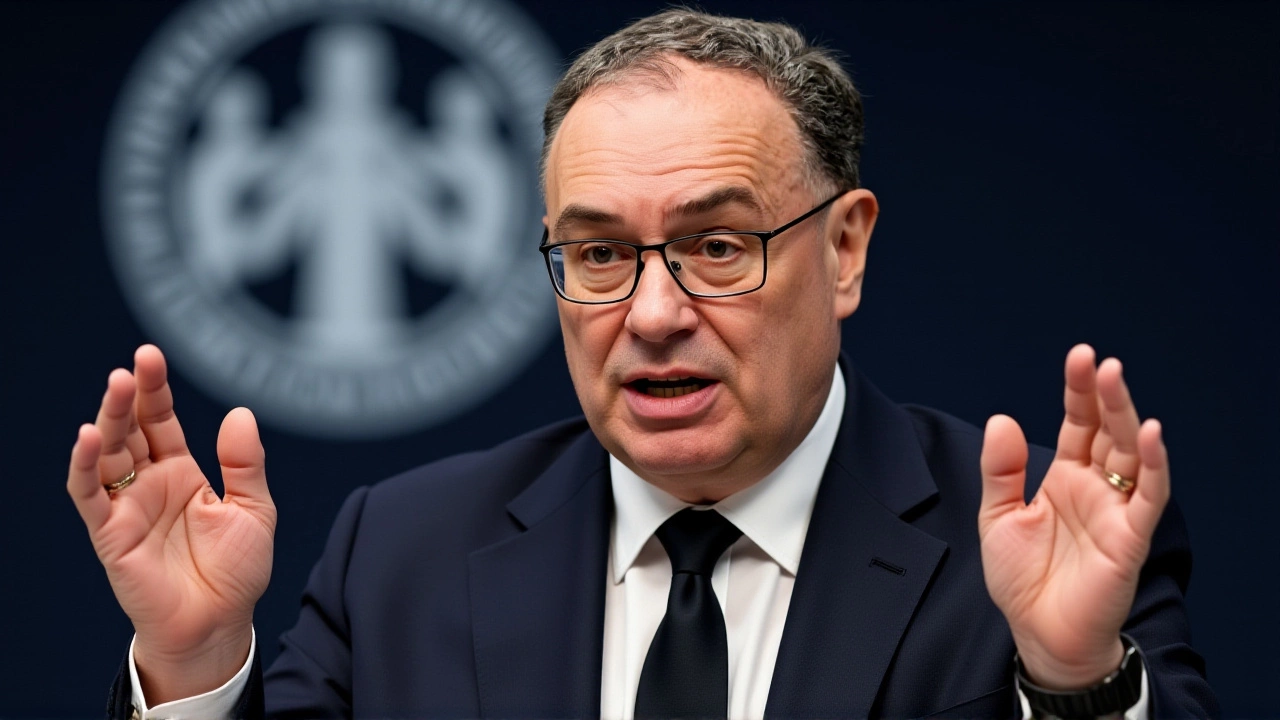
On July 15, 2025, Andrew Bailey, Governor of the Bank of England, stood before 350 financial leaders at Mansion House in London and issued a blunt warning: the world’s economic safety net is fraying, and the United States must step up. His 45-minute speech, delivered at the Annual Financial and Professional Services Dinner, wasn’t just another policy address. It was a call to action — and a rare public nudge to Washington to stop sitting on the sidelines while global imbalances grow more dangerous.
Three Reforms, One Goal: Stopping the Next Crisis
Bailey didn’t mince words. He laid out three concrete proposals for the International Monetary Fund — reforms that, if adopted, could reshape how the world manages economic shocks. First, the IMF must deepen its analysis of trade imbalances, paying closer attention to how one country’s policies ripple across borders. Second, its advice in Article IV reports — the annual economic check-ups it gives member nations — needs more "bite." Right now, it’s often polite. Bailey wants it to be piercing. Third, and most innovative, he urged the IMF to team up with the World Trade Organization. Imagine macroeconomic experts and trade lawyers sitting in the same room, diagnosing how subsidies in Berlin or Detroit distort global markets. "Bringing industrial policies and subsidies into a macroeconomic framework is not straightforward," Bailey said, referencing conversations with Secretary Bessent (U.S. Treasury Secretary). "But it is fair to ask the question. And the IMF can answer it."Why the U.S. Matters — And Why It’s Holding Back
Here’s the twist: Bailey didn’t just want reform. He wanted American reform. The IMF’s voting power still rests heavily on Washington’s shoulders. And while European and Asian nations have quietly pushed for change, the U.S. has stayed silent. Bailey noted the "growing resistance to regulation and rule-making" — a phenomenon Hyman Minsky warned about decades ago. As memories of the 2008 crisis fade, so does the appetite for tough oversight. But Bailey pointed to this year’s market turbulence — currency swings, debt spikes in emerging markets, sudden capital flight — as proof the system is already cracking. "Deficit countries have historically faced far more pressure to correct excess current account balances than surplus countries," he said. That imbalance isn’t just unfair. It’s unstable.A Legacy of Shallow Multilateralism
This wasn’t Bailey’s first warning. In January 2025, at Cambridge University, he called the original Bretton Woods system — established in 1944 — "shallow multilateralism" that "didn’t pass the test." He was echoing Harvard economist Dani Rodrik. Back then, the IMF and World Bank were designed for a world of fixed exchange rates and colonial-era trade flows. Today, they’re grappling with algorithmic trading, digital currencies, and supply chains that span six continents. The institutions haven’t kept pace. Bailey’s message was clear: evolution isn’t optional. "Even if issues around voting shares remain to be resolved," he acknowledged, "the Fund has been able to evolve its toolkit." But evolution isn’t enough. It needs momentum. And right now, that momentum is stuck in Washington.
From Surveillance to System-Wide Stress Tests
Bailey didn’t stop at criticism. He offered a path forward. He announced that through the Financial Stability Board, the Bank of England will collaborate with the IMF on system-wide stress tests — the kind the BoE pioneered last year with its System Wide Exploratory Scenario. Think of it as a global financial MRI: scanning not just individual banks, but entire networks of cross-border lending, currency swaps, and sovereign debt holdings. The goal? Spotting where the next shock might hit — before it hits. "Capturing the nature and extent of international spillovers," Bailey said, "lies at the heart of what we must seek to do here."What’s Next? The 2025–2026 IMF Cycle
The real test comes next year. The IMF and World Bank hold their annual meetings in October 2025, followed by the Spring 2026 gathering. That’s when Bailey’s proposals will be formally debated. The U.S. Treasury’s response — or lack thereof — will speak volumes. Will Washington reassert its leadership? Or will it let Europe and emerging economies push reform alone? The answer will determine whether the global financial system can weather the next crisis… or collapse under its weight.
Why This Isn’t Just About Money
This isn’t a technical debate. It’s about power. About fairness. About whether the world still believes in rules that apply to everyone — or only to those who can afford to ignore them. Bailey’s speech came amid the International Institute of Finance’s Global Outlook ForumWashington, D.C., where participants warned of "diminishing support for multilateralism" and "fragmented policy landscapes." That’s the real threat: not just economic imbalance, but institutional irrelevance. If the IMF and World Bank become toothless relics, who steps in? Markets? Unregulated hedge funds? China’s Belt and Road? The stakes aren’t just financial. They’re geopolitical.Frequently Asked Questions
Why does the U.S. have so much influence over the IMF?
The U.S. holds about 16.5% of voting power in the IMF — just enough to block major reforms requiring an 85% supermajority. This structure dates back to 1944, when the U.S. accounted for nearly half the global economy. Today, its share is far smaller, but the voting rules haven’t changed. That’s why even modest reforms, like shifting voting weights to emerging economies, stall without American approval.
What’s the "System Wide Exploratory Scenario" and why does it matter?
Developed by the Bank of England in 2024, this scenario simulates how financial stress spreads across borders — not just through banks, but through shadow lenders, commodity chains, and currency markets. It’s the first time a central bank has tested system-wide contagion at this scale. The IMF now wants to adopt it globally. If successful, it could become the new gold standard for detecting hidden risks in the global financial system.
How do current account imbalances threaten global stability?
When one country runs a massive trade surplus (like Germany or China) and another runs a deficit (like the U.S. or UK), capital flows from surplus to deficit nations — often into risky assets. When confidence shifts, those flows reverse suddenly, triggering currency crashes and debt defaults. This cycle, repeated since the 1990s, fueled the Asian Financial Crisis and the 2008 meltdown. Without better surveillance, history could repeat.
Why hasn’t the IMF acted on these issues before?
Because it lacks enforcement power. The IMF can issue warnings, but it can’t force countries to change policy. And powerful nations — especially surplus countries — resist scrutiny. The U.S. has long blocked IMF reports that criticize its fiscal deficits, while China and Germany have resisted pressure to revalue their currencies. Without political will, even the best analysis sits on a shelf.
What’s the connection between industrial subsidies and global imbalances?
When governments heavily subsidize industries — say, U.S. chipmakers or EU green tech — they distort global trade. Other countries respond with tariffs or their own subsidies, creating trade wars. The IMF hasn’t traditionally analyzed these policies as macroeconomic risks. But with $1.2 trillion in global industrial subsidies in 2024 (OECD data), that gap is dangerous. Combining IMF macro expertise with WTO trade data could finally connect the dots.
Is there historical precedent for this kind of IMF reform?
Yes. After the 2008 crisis, the IMF expanded its surveillance to include financial sector risks — something it had largely ignored before. That change, pushed by the G20, saved the global system during the 2020 pandemic. Bailey’s proposal follows the same logic: adapt to new threats. The question isn’t whether reform is needed — it’s whether the political will exists to make it happen.